00In brief
Voyager 1 will reach 1 light-day distance on Nov. 18, 2026, at 5:16:07 a.m. EST (1016 GMT).[1][2][4]
The spacecraft launched on Sept. 5, 1977, from Kennedy Space Center.[1][2][4]
Distance from Earth: roughly 16 billion miles (26 billion km) per NASA.[1][2][4]
Radio signals take 24 hours one-way, resulting in a 48-hour round-trip latency.[1][2][4]
NASA's Voyager 2 is at 13.5 billion miles and will hit the milestone around 2035.[1][2]
01What happened
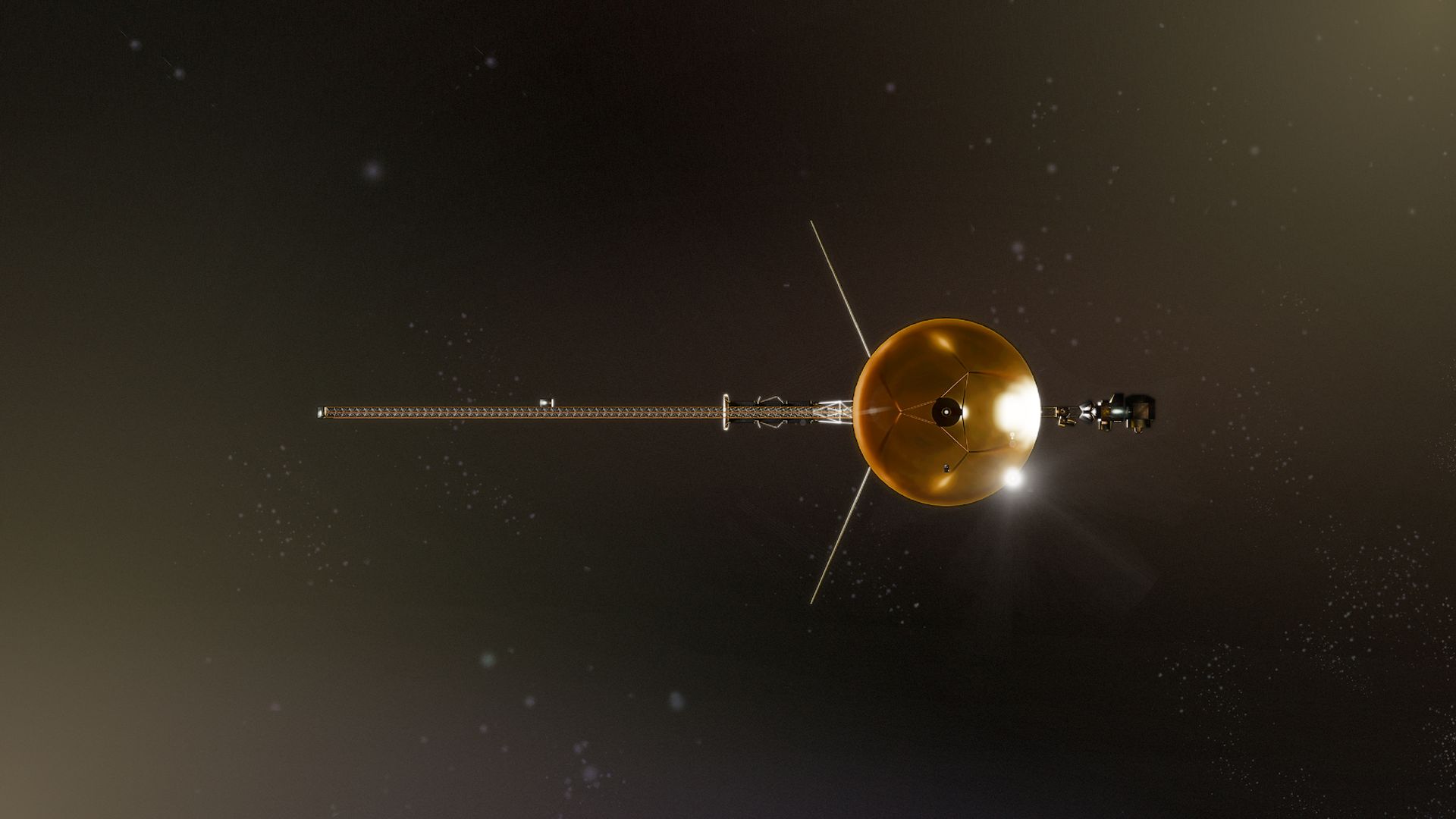
NASA's Voyager 1 spacecraft is on the verge of becoming the first human-made object to reach one light-day from Earth. The milestone is set to occur on Nov. 18, 2026, at 5:16:07 a.m. EST (1016 GMT), when the probe will be 49 years, two months and 11 days old. Voyager 1 launched in 1977 and is currently traveling through the constellation Ophiuchus, according to NASA official Jeffrey Hayes.[1][2][4]
One light-day is the distance light travels in 24 hours, approximately 16.094 billion miles (25.902 billion km). At that range, a radio command from Earth takes a full day to reach Voyager 1, and its reply then takes another day to return, creating a minimum 48-hour round-trip delay. The spacecraft remains in contact with Earth via the Madrid station of the Deep Space Network.[1][2][4][5]
To commemorate the event, NASA has invited the public to take part in the 'Shine Bright for Voyager's Light-Day' event on Nov. 17. Participants are asked to flash the Morse code for 'V-G-R'—Voyager's call sign—towards the night sky after sunset using a flashlight or smartphone. NASA provides an automated Morse code flasher at science.nasa.gov/specials/apps/voyager-one-light-day.[4][5]
02Who said what
Jeffrey Hayes, a NASA discipline scientist overseeing Voyager 1, said the milestone 'essentially kicks off the year's worth of celebrations leading up to the 50th anniversary' in 2027. He described the spacecraft as 'fragile' due to its age and the extreme cold of interstellar space, adding that the environment is 'only a few degrees above absolute zero.'[1][2]
03What is still unknown
Sources do not specify how much power remains available for Voyager 1's instruments after the 2026 'Big Bang' power swap, nor do they list which specific instruments are still active. Hayes's comments on instrument prioritisation leave the exact selection unknown, as the sources list no detailed instrument roster.[1][2]
Neither source provides a current estimate of Voyager 1's remaining operational lifetime beyond the 2022 projection of the 2030s. The sources do not say whether NASA has updated that timeline in light of the recent power-swap manoeuvre.[1][2]
The exact distance in miles cited differs between sources (e.g., 'roughly 16 billion miles' in Space.com and YAHOO! versus '16.094 billion miles' in anews). Sources do not explain the discrepancy or which figure is the official NASA measurement.[1][2][4]
Sources
- [1]Space.comNASA's interstellar Voyager 1 probe is about to reach 1 light-day from Earth after nearly 50 years in space
- [2]YAHOO!NASA's interstellar Voyager 1 probe is about to reach 1 light-day from Earth after nearly 50 years in space
- [3]South China Morning PostNasa’s Voyager 1 to make history by reaching a light-day from Earth
- [4]anewsNASA's Voyager 1 to reach historic one-light-day distance from Earth on Nov. 18
- [5]Mashable IndiaVoyager 1 Is One Light-Day Away From Earth; NASA Wants You To Flash V-G-R In Morse Code
- [6]WBAL NewsRadio 1090/FM 101.5A NASA probe from the ’70s is still talking, and Wednesday it will be a light-day away