00In brief
One light-day equals approximately 16 billion miles (about 26 billion kilometres).[1][2][3]
Voyager 1 launched on September 5, 1977, from Cape Canaveral, Florida.[1][2]
Voyager 1 discovered active volcanoes on Jupiter's moon Io and a thick atmosphere on Saturn's moon Titan.[1][3]
Voyager 1 crossed into interstellar space on August 25, 2012.[1][2]
01What happened
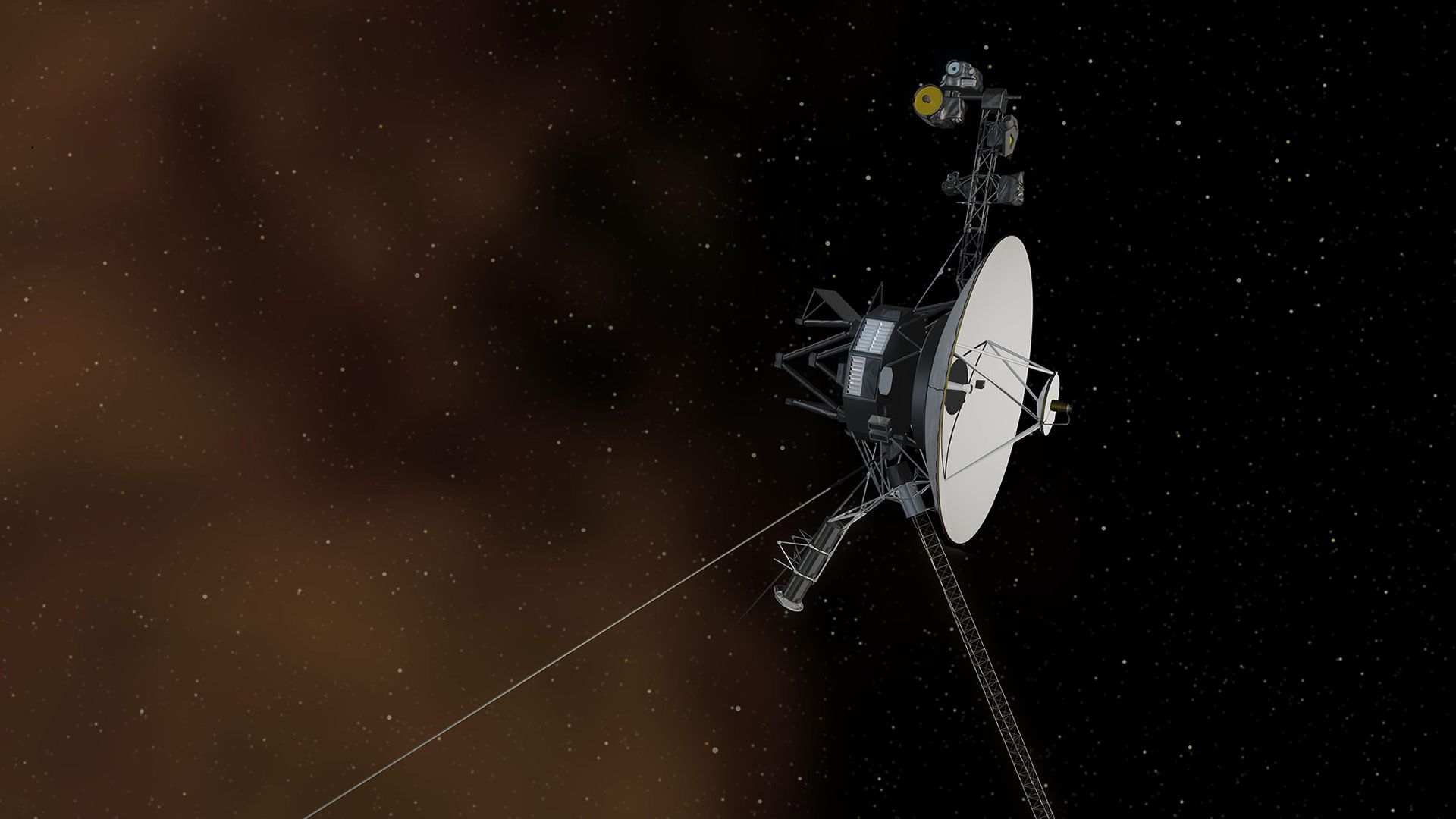
NASA's Voyager 1 spacecraft has become the first human-made object to reach a distance of one light-day from Earth. At 5:16 a.m. EST (1016 GMT) on November 18, 2026, the probe achieved a distance of about 16 billion miles (approximately 26 billion kilometres), the equivalent of 24 hours of light travel.[1][2][3]
Voyager 1 was launched on September 5, 1977, from Cape Canaveral, Florida, on a faster trajectory than its twin, Voyager 2. It has now travelled more than 63,000 times farther than the human distance record set by the Artemis II mission, which reached 252,756 miles in April 2026.[1][2][3]
The spacecraft has been operating for nearly 49 years and continues to send back data from interstellar space, which it entered on August 25, 2012. Its instruments now measure magnetic fields, particles and plasma beyond the heliosphere.[1][2][5]
02Who said what
Voyager Project Scientist Linda Spilker stated: "The Earth and Voyager are exactly 24 hours apart at the speed of light." She called the achievement "a very special moment" for the first human-made object to reach one light-day distance, according to Space.com.[1]
03Where the sources differ
Sources differ on the exact distance value: Space.com reports 16.1 billion miles, Yahoo News Canada states 16 billion miles (25.9 billion kilometres), and Yahoo News UK says 16 billion miles (about 26 billion kilometres). The New York Times headline was available but the full text could not be fetched, so no comparison is possible for that source.[1][2][3]
Yahoo News Canada notes that eight of Voyager 1's original ten instruments are not operating and that the plutonium-238 power source degrades each year, while Space.com does not mention these technical details. Yahoo News UK and KATV do not discuss instrument status.[2]
The exact time of the milestone is reported as 5:16 a.m. EST by both Space.com and Yahoo News Canada, but Yahoo News UK specifies 10:16:07 GMT, which corresponds to the same moment. KATV refers to the event occurring "tomorrow morning" from its publication date, without a precise time.[1][2][3][5]
04What is still unknown
The sources do not specify how much longer Voyager 1's power supply will allow it to operate. Yahoo News Canada mentions that signals may cease within the next decade, but Space.com and Yahoo News UK give no end-date estimate.[1][2][3]
It is unclear whether Voyager 1 will cross any further distance milestones, such as two light-days, before losing power. The sources do not discuss future milestones beyond the current one.[1][2][3][5]
The exact scientific discoveries made by Voyager 1 in interstellar space since 2012 are not detailed in the sources. While KATV notes it measures magnetic fields and plasma, no specific findings are provided.[1][2][3][5]
Sources
- [1]Space.com1 light-day from Earth! NASA's Voyager 1 probe hits huge milestone in interstellar space
- [2]Yahoo News CanadaNASA’s Voyager 1 has reached 1 light‑day from Earth, the first human‑made object in space to reach that distance
- [3]Yahoo News UKNasa’s Voyager 1 probe, launched in 1977, reaches distance milestone of one light-day from Earth
- [4]The New York TimesAfter 49 Years, Voyager 1 Is a Mind-Blowing One Light-Day From Earth
- [5]KATVTomorrow, Voyager 1 hits a light-day from Earth, turning calls home into 24-hour trips