00In brief
01What happened
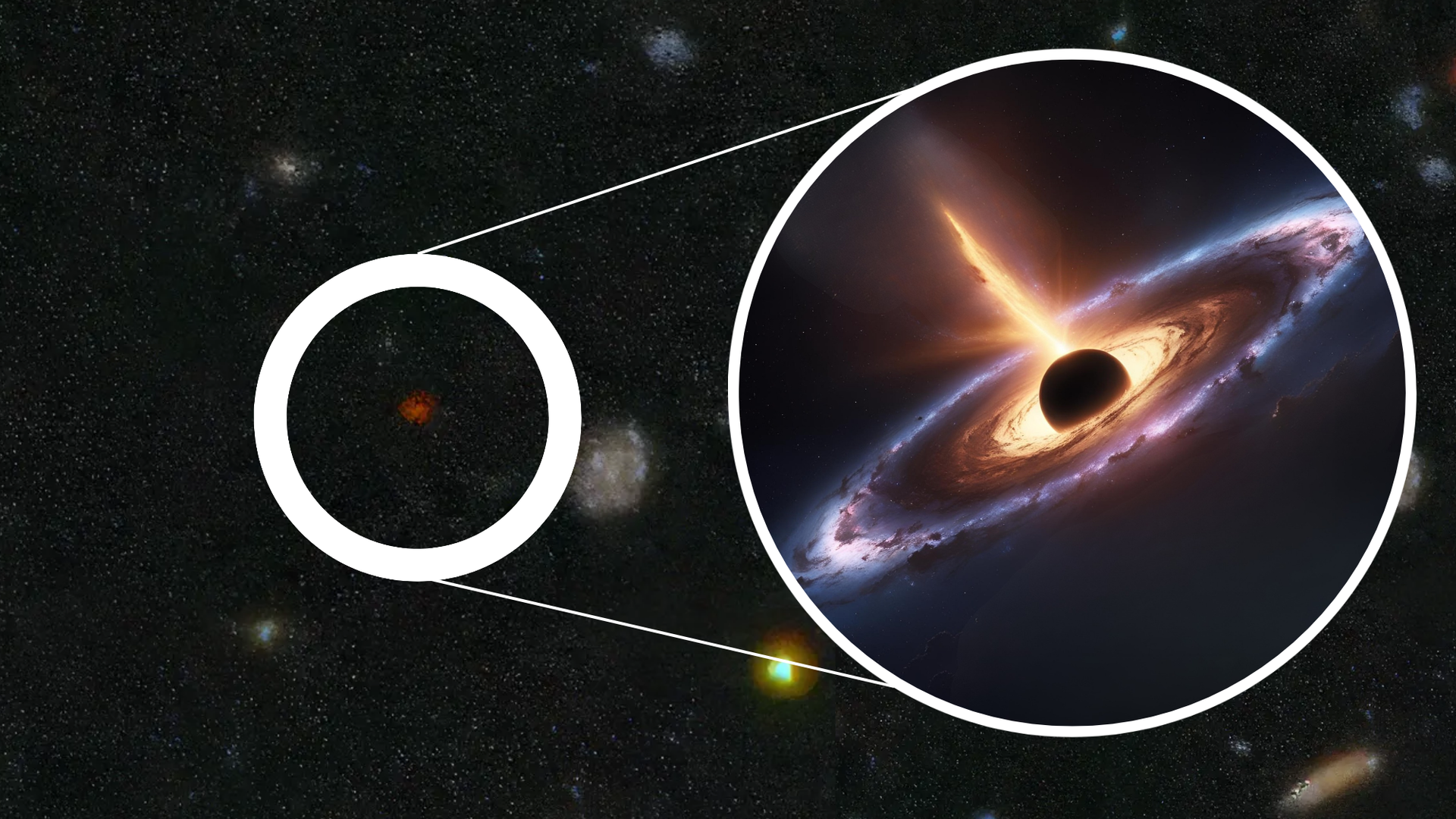
Astronomers using the Euclid space telescope have identified the most distant and ancient quasar ever observed. The object, named J1504+6252 and nicknamed Dún Aonghasa, is powered by a supermassive black hole with a mass of 360 million Suns. It was seen as it appeared just 630 million years after the Big Bang, pushing back the known frontier of quasar observations by 40 million years.[1]
The discovery was made among millions of objects in 18 months of Euclid data and confirmed by follow-up observations using the W.M. Keck Observatory, the Large Binocular Telescope Observatory, the Hubble Space Telescope, and the James Webb Space Telescope, which measured the black hole's mass. In a separate development, researchers using the Atacama Large Millimeter/submillimeter Array (ALMA) in Chile weighed a black hole in the distant dust-shrouded quasar W2246-0526, which existed when the universe was about 1.3 billion years old.[1][2]
Euclid's primary mission is to study dark energy and dark matter, but the telescope has also discovered at least 12 quasars dating back around 13 billion years, showing its unexpected value for black hole research. The ALMA study, reported in Science Advances, marks the first time the region where a black hole's gravity dominates has been resolved at such a distance without the aid of gravitational lensing.[1][2]
02Who said what
The Space.com article attributes the discovery to the Euclid collaboration and notes that the team's research was published on 24 November 2026 in Astronomy & Astrophysics. The ALMA study, described by Knowridge Science Report, involved researchers who used the motions of gas to derive the black hole's mass, offering a check on earlier mass estimates based on brightness and wavelength spread.[1][2]
The Space.com article further notes that Euclid's nickname is the "dark universe detective" because its main goal is understanding dark energy and dark matter, which together account for about 95% of the universe's matter-energy budget. No direct quotes from the researchers are provided in either source.[1]
03What is still unknown
The sources do not explain how Dún Aonghasa's supermassive black hole reached a mass of 360 million Suns within 630 million years of the Big Bang, when theoretical models suggest such growth should take about 1 billion years. Space.com also raises but does not clarify why this black hole is feeding relatively slowly, despite its early appearance. Knowridge Science Report does not address whether the dust-shielding hypothesis for ALMA's success applies to other distant quasars.[1][2]
It is unclear whether the Euclid telescope will detect even older quasars beyond Dún Aonghasa, as the article notes it is the most distant ever seen but does not set a limit on Euclid's reach. The ALMA study does not specify how the mass of the black hole in W2246-0526 compares with earlier estimates for that object.[1][2]
Sources
- [1]Space.comAstronomers discover the most distant and ancient supermassive black hole-powered quasar in the universe
- [2]Knowridge Science ReportMoving gas reveals the mass of an ancient giant black hole