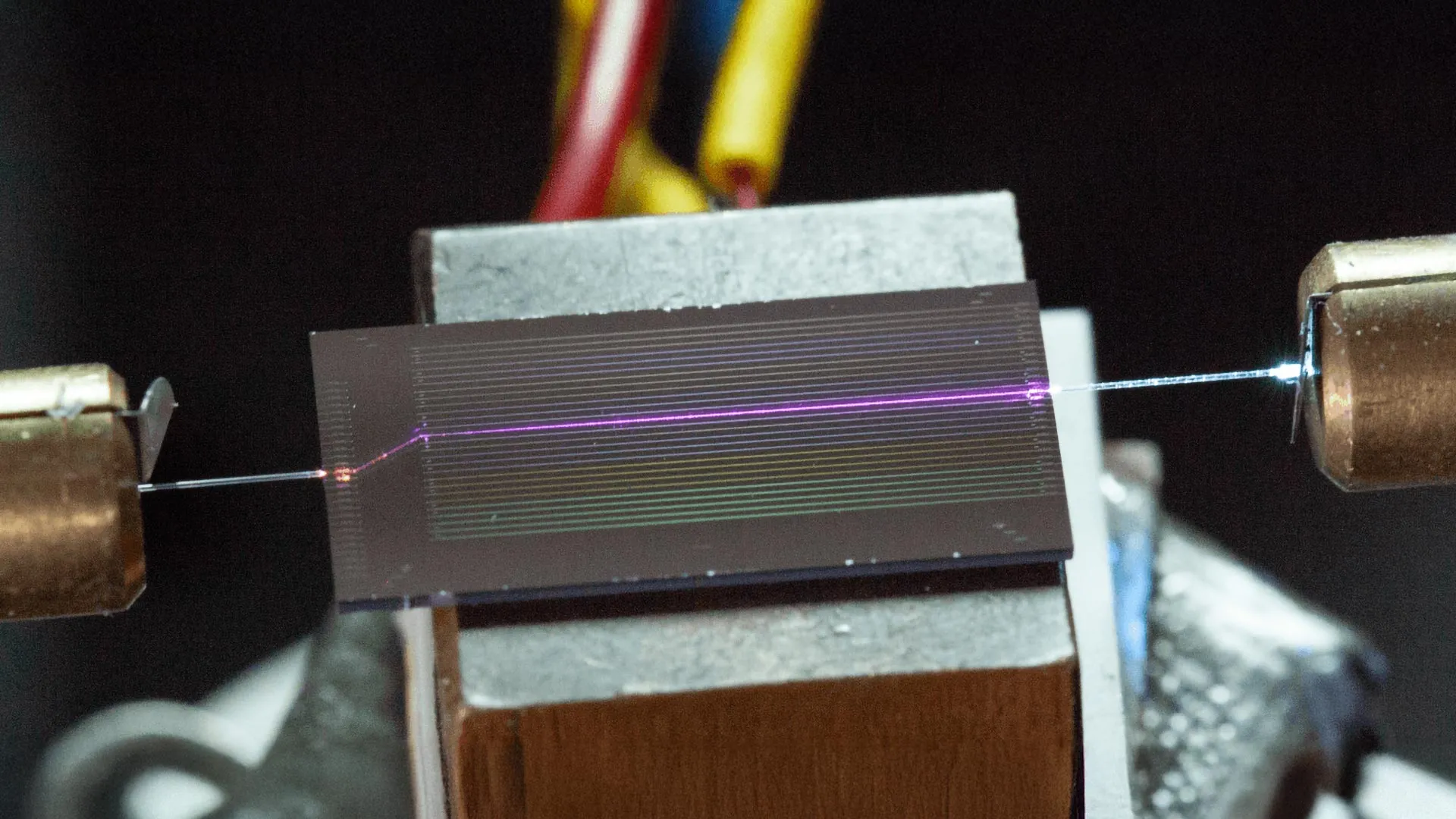
A Harvard-led team has created a microscopic chip that uses red light to generate 120 times more ultraviolet light than previous devices, overcoming a key barrier to miniaturising quantum computers and atomic clocks.
01Summary
- 01The device, made of thin-film lithium niobate, produces 4.2 milliwatts of UV light at 390 nanometres via frequency upconversion.
- 02Previous thin-film lithium niobate UV sources generated only tens of microwatts, making them impractical for real-world use.
- 03The team developed a technique called 'sidewall poling' to reverse crystal domains at sub-micrometre scales across centimetre-long waveguides.
- 04The research was published in Nature Communications and led by Professor Marko Lončar's lab at Harvard University.
- 05Applications include trapped-ion quantum computers, ultra-precise atomic clocks and compact environmental sensors for greenhouse gases.
02Why it matters
This breakthrough could reduce the size of quantum computers from truck-sized installations to chip-scale devices, and enable portable atomic clocks and sensors for atmospheric monitoring.
Pulse AIAsk about this story
Answers are generated by AI from the story summary; they are not investment, health or legal advice.