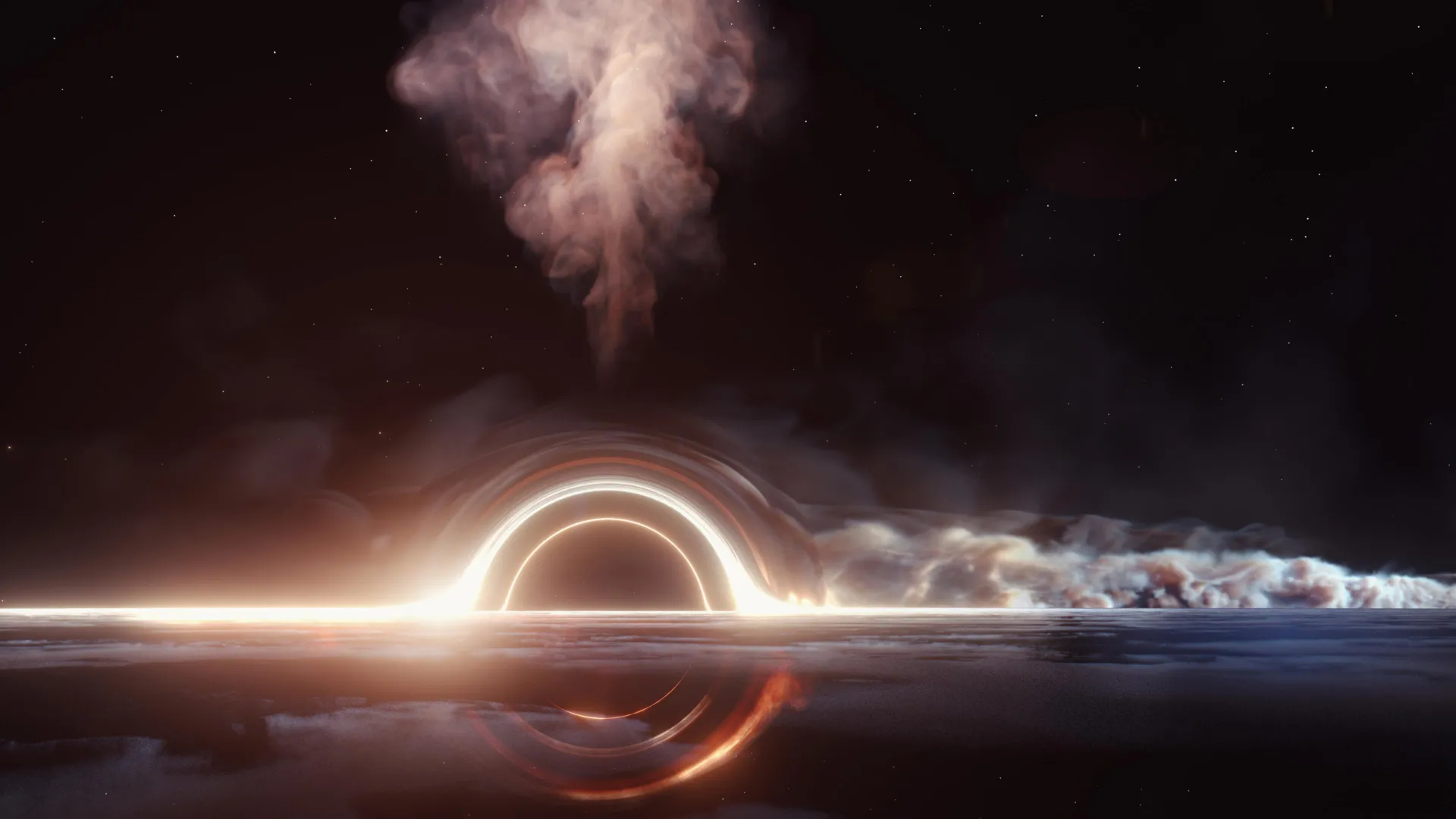
Black holes of vastly different masses follow the same rule when launching jets, activating delayed outflows when their feeding rate drops to 2% of the Eddington limit. The discovery could help predict when black holes erupt after destroying stars.
01Summary
- 01The research, published in Nature Astronomy, was led by Dr. Adelle Goodwin at Curtin University and Dr. Andrew Mummery at the Institute for Advanced Study in Princeton.
- 02The team analysed 10 tidal disruption events using observations from telescopes in Australia, the United States, India, South Africa, and space.
- 03Delayed jets appear when the black hole's feeding rate falls to approximately 2% of the Eddington limit, the same threshold seen in much smaller black holes in the Milky Way.
- 04Tidal disruption events occur when a star is torn apart by a supermassive black hole, temporarily increasing its feeding over a few years.
- 05The insight came to the researchers during a conversation at a bar in Madrid while attending a scientific conference.
02Why it matters
This finding gives astronomers a tool to predict when supermassive black holes will produce powerful radio jets after destroying stars, potentially years later. It also reveals a fundamental physical process that governs black hole behaviour across the universe, regardless of their size.
Pulse AIAsk about this story
Answers are generated by AI from the story summary; they are not investment, health or legal advice.