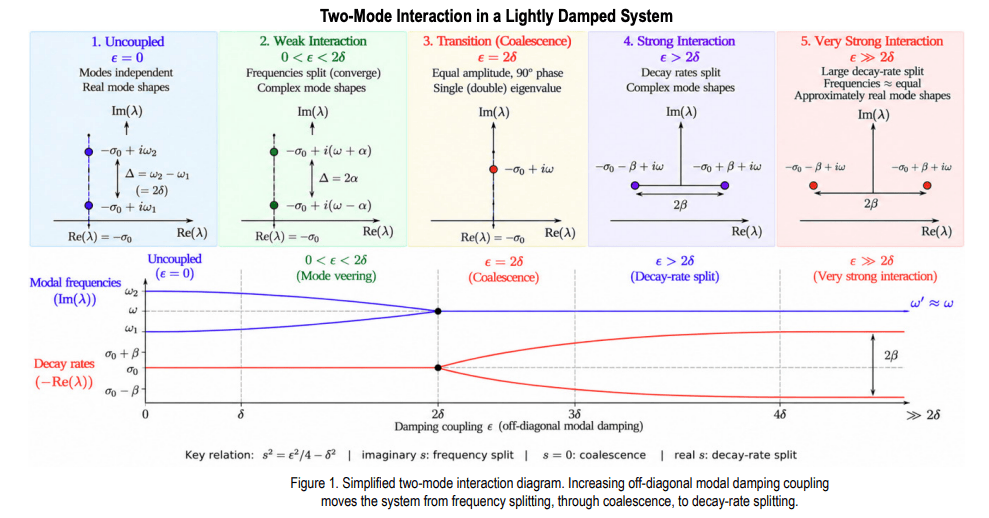
NASA says lightly damped structures can still show complex mode shapes when two close modes interact through nonproportional damping. As the coupling grows, frequencies move together, then coalesce, before decay rates split apart.
01Summary
- 01NASA’s Langley Research Center says complex mode shapes can appear in a linear structure even when overall damping is low.
- 02The effect occurs when two structural modes are close in frequency and are coupled through nonproportional damping.
- 03The article says that as damping interaction increases, the two modal frequencies move towards one another and can coalesce at a critical level.
- 04Beyond that point, the frequencies stay approximately equal while the modal decay rates separate.
- 05The paper is identified as NASA/TM-20260007553 and is dated August 2026.
02Why it matters
This matters because complex-looking vibration data does not automatically mean a structure is badly damped or behaving nonlinearly. Engineers can use the framework to interpret close-mode pairs more accurately and judge how near they are to the transition point.
Pulse AIAsk about this story
Answers are generated by AI from the story summary; they are not investment, health or legal advice.