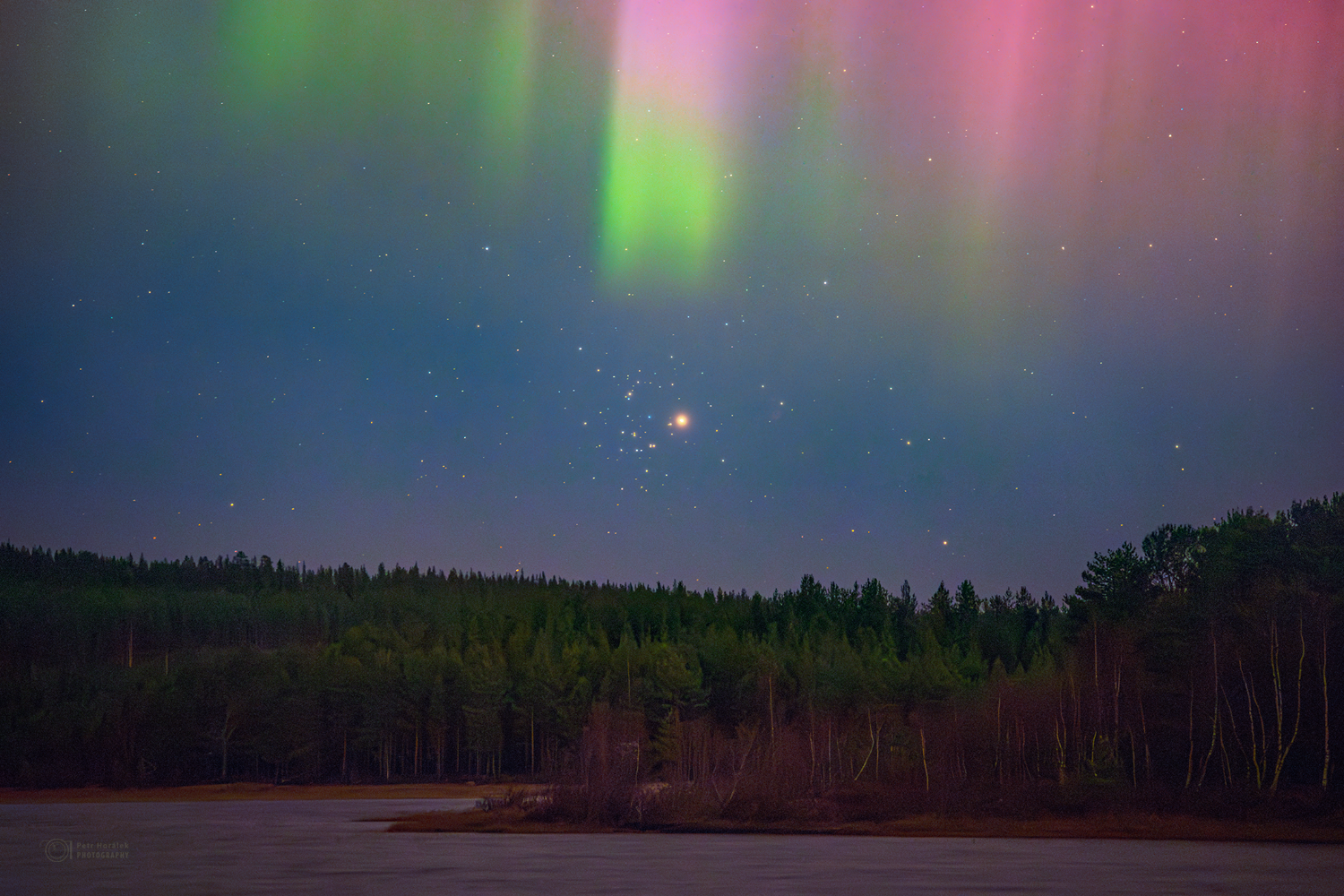
NASA’s picture shows Mars beside the Beehive star cluster under a bright aurora near Lansjärv, Sweden. The aurora followed a solar eruption that reached Earth on 10 October 2026.
01Summary
- 01The image was taken near Lansjärv, Sweden, with Mars below an auroral curtain and above a horizon of trees.
- 02NASA says a solar eruption on 10 October 2026 caused strong disturbances in Earth’s magnetic field.
- 03The energetic particles from that eruption produced the colourful aurora seen in the picture.
- 04Mars appeared closest to the centre of the Beehive cluster, also known as M44 or Praesepe, at the time.
- 05The text says the Beehive cluster is a swarm of young stars, not bees.
02Why it matters
The picture links a striking sky event to activity on the Sun, showing how solar eruptions can affect Earth’s magnetic field and create auroras. It also highlights a rare alignment of Mars with a well-known star cluster.
Pulse AIAsk about this story
Answers are generated by AI from the story summary; they are not investment, health or legal advice.